In this article
Key takeaways
- Kuwait is a video market: 69% of Arabic ads shown in Kuwait are video, and single images only 17%.
- "Shop now" is the top button (42%), then "WhatsApp message" (22%) and "Order now" (17%). An agency that knows Kuwait tests all three.
- The median advertised price is KWD 20; cash on delivery is in 14% of ads and instalments in only 1%.
- Ads that live 30 days or more are rare (<1% of Kuwait ads): when an agency shows you its clients' ads, ask about running time, not count.
What advertisers in Kuwait run right now
Before judging an agency, know the benchmark. In the study window, 28,283 Arabic ads from 5,027 advertiser pages ran in Kuwait. The dominant format is video (69%), then single images (17%) and carousels (6%). An agency that proposes a plan of static images only is working against the market.
What the ads offer: a discount or an offer in 34%, urgency ("limited time" and the like) in 15%, free delivery in 13%, a gift in 10%. Cash on delivery is mentioned in only 14%, and instalments with Tabby or Tamara in 1%: Kuwait is an online-payment market, and a Kuwaiti ad does not need to reassure the buyer about payment as much as it needs to state the dinar price and the delivery.
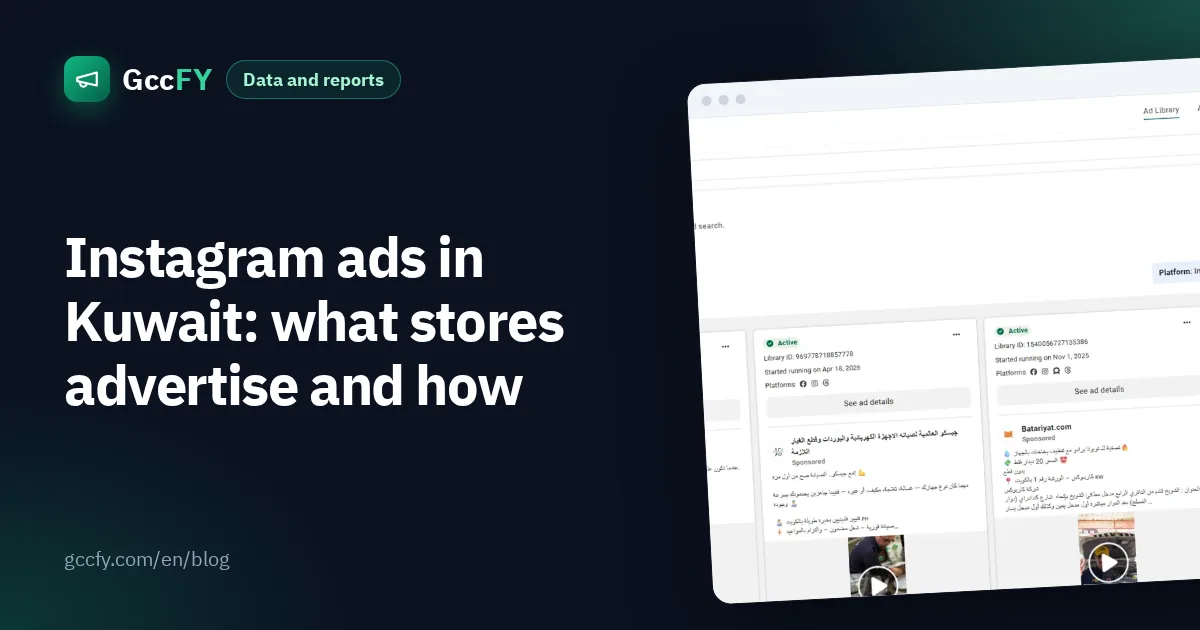
Buttons: "Shop now" on 42% of ads, "WhatsApp message" on 22%, "Order now" on 17%. Destinations: 24% of ads end in a WhatsApp chat with no store, 15% lead to a Shopify store, and Salla and WooCommerce take about two percent each. The full picture is in Instagram ads in Kuwait and Trending in Kuwait.
What sells through ads in Kuwait, and at what price
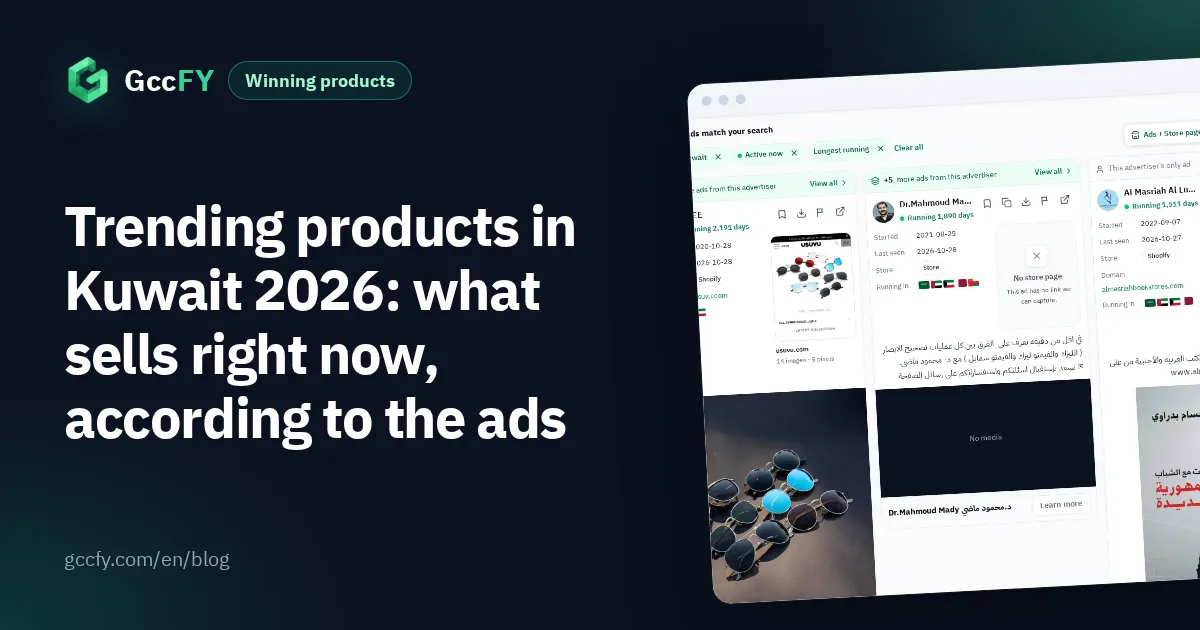
Fashion and shoes lead (12% of Kuwait ads), then electronics (12%), hair care (10%), health and supplements (10%), watches and accessories (9%) and perfumes (8%). An ad can fall in more than one category.
Prices: of 2,295 ads that stated a price in dinars, the lower quartile is up to KWD 12, the median 20, the upper quartile from KWD 46. That is the "buy straight from the ad" range in Kuwait. If your product costs much more, ask the agency how it sells a product that needs more than one click, not how it lowers the cost per click.
Why does this matter when choosing an agency? Because the first test is simple: ask the agency which format dominates in Kuwait, which button works in your category, and which price range sells through ads. An agency working in the market answers from experience; an agency managing accounts from abroad answers in generalities.
The checklist: verify an agency's work yourself in twenty minutes
- Ask for its clients' page names on Facebook and Instagram, not screenshots or "case studies" with numbers nobody can verify. A confident agency gives you three or more pages whose ads it runs right now.
- Open them on the Advertisers screen: choose Kuwait and type the page name in the search box (it searches page names). You see every ad of that page we collected, active and stopped, with the days each ad ran. A page that does not appear has not advertised in Arabic in the Gulf in the period we cover, so ask why.
- Read running time, not count. Dozens of ads that lived two days mean wide testing, and may mean nothing worked. One ad running for weeks means the client pays for it because they see results. In all of Kuwait only <1% of ads reach 30 days; an agency with several such ads for its clients knows what it is doing. Details in Ad running time.
- Open the landing pages. GccFY keeps a snapshot of the store page behind every ad. Is the dinar price clear? Is delivery inside Kuwait stated? Does the page carry a Meta pixel at all? An agency running ads for a store without a pixel is spending its client's budget blind. How to read pixels: Salla, Zid and Shopify pixels.
- Compare with competitors. On the same screen sort Kuwait by most ads and open three advertisers in the agency client's category. Are the client's ads like the market, weaker, or better? The comparison method is in Competitor ads.
All of this is public information: the ads are in Meta's Ad Library and landing pages are public. You will not see the agency's budget or results, but you see what it runs and how long it lasted, which is more honest than any pitch deck.
Questions to ask the agency
| Question | A good answer | A worrying answer |
|---|---|---|
| Who owns the ad account and the pixel? | You do; the agency is added as a partner and removed when the contract ends. | The agency runs from its own account and sends you "reports". |
| How many ads do you test a month, and what happens to losers? | A set number, and a clear stop rule after a few days. | "We optimise continuously", with no numbers. |
| Who makes the video? | A clear plan: the client, a videographer or the agency's team, with a monthly number of videos. | "Send us what you have", in a market where 69% of ads are video. |
| WhatsApp, the store, or "Order now"? | It proposes testing both destinations and measuring each on its own. | One method for every client. |
| What gets measured? | Cost per order, or per conversation that ends in a sale, not views. | Reach, impressions and likes. |
| Do you guarantee a return? | Nobody guarantees an ad auction; it gives you a range from similar clients' experience. | A guaranteed return or "results from the first week". |
Add one last question: "Show me an ad you stopped, and why." The agency that talks plainly about failure is the one that learns from its tests.
Warning signs, and reassuring signs
- Warning: "We can see competitors' budgets and targeting." For commercial ads in the Gulf the library shows neither spend nor targeting; what you see is the ad itself and its running time.
- Warning: a portfolio made entirely of screenshots with no page names you can open.
- Warning: a long contract with no trial period, or a management fee that never changes whatever the budget and the result.
- Reassuring: the agency proposes the first month as a test with a small budget and several angles, and sets in advance what will be measured.
- Reassuring: it asks for access to the store to check the pixel and page speed before running a single dinar.
- Reassuring: it knows Kuwait's seasons (National and Liberation Days on 25 and 26 February, Ramadan, White Friday) and plans weeks ahead of them. The dates are in our Gulf seasons calendar.
And if you decide to run your own ads?
Many small Kuwaiti stores run their ads from an Instagram account directly, and that works if you keep to the basics: short vertical video with a dinar price and clear delivery, a pixel installed before the first ad, two buttons tested, and a weekly read of competitors' ads in Kuwait. GccFY gives you the last part ready: the ads shown in Kuwait, sorted by longest running, with the store page behind each one. And if you pick an agency later, you will know how to judge it. If your store runs on Shopify, read Shopify agency in the Gulf too.