In this article
Key takeaways
- Every active ad of a competitor is in the Facebook Ad Library: search their Page name, not a generic keyword.
- Record the same things from every ad: offer, angle, format, button and running time.
- The ad is half the story: the landing page shows price, delivery and payment options.
- Among the newest 20,000 Arabic ads in our library, 53% of advertisers appeared with a single ad and 6% with more than ten at once. Those are scaling what works: watch them first.
Why follow competitors' ads?
An ad that keeps running for weeks tells you things no market study will: which offer convinces buyers right now, which price they accept, and which kind of video stops them from scrolling. Your competitor paid for that information from their budget; you read it for free.
Following is not copying. The goal is to understand the market: what is so common it no longer stands out, which gap nobody fills, and which angle you can deliver better than anyone.
Step 1: identify your real competitors
Start with a short list of three kinds:
- Direct competitors: same product, same country. Search your product on Google, on Salla and Zid stores, and notice the ads you see after browsing similar products.
- Indirect competitors: they solve the same problem with a different product, such as a perfume store selling bakhoor and a store selling home fragrance.
- Big brands in your category: you will not beat them on price, but they test with large budgets, so their ads show the direction of the market.
Ten names are enough to start. Following them regularly matters more than a long list you never open again.
Step 2: find all of their ads
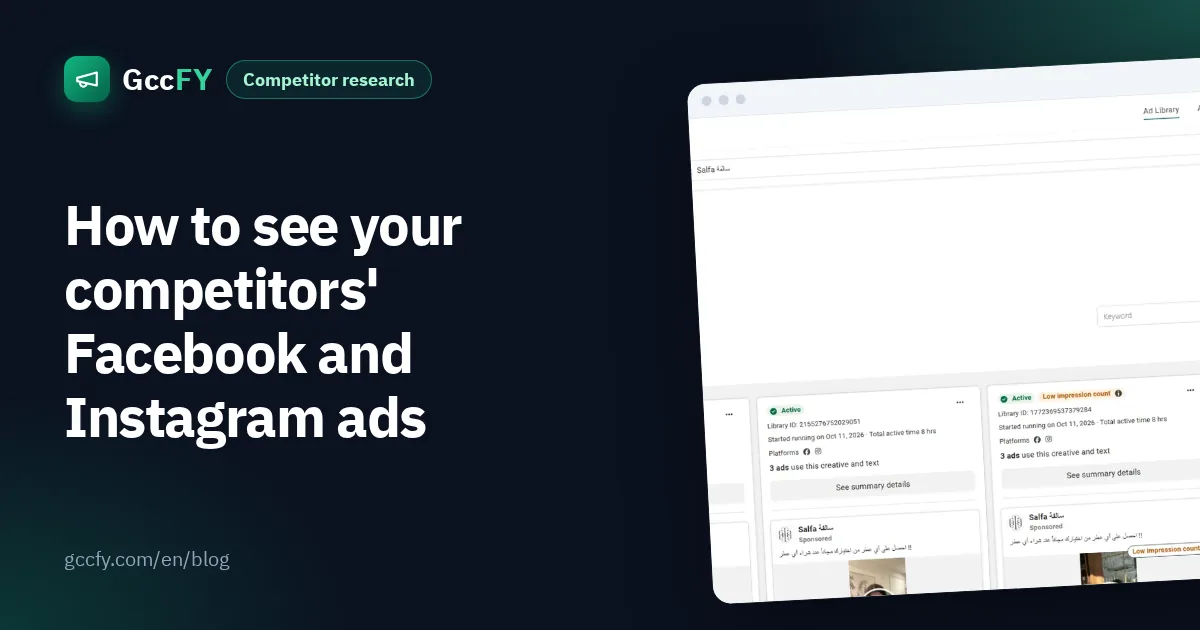
In the Facebook Ad Library, pick the country and "All ads", type the competitor's Page name and select the Page from the suggestions. You will see all of their active ads with the start date of each. On the competitor's Facebook Page itself, the "Page transparency" section links to the same ads and shows when the Page was created and how its name changed.
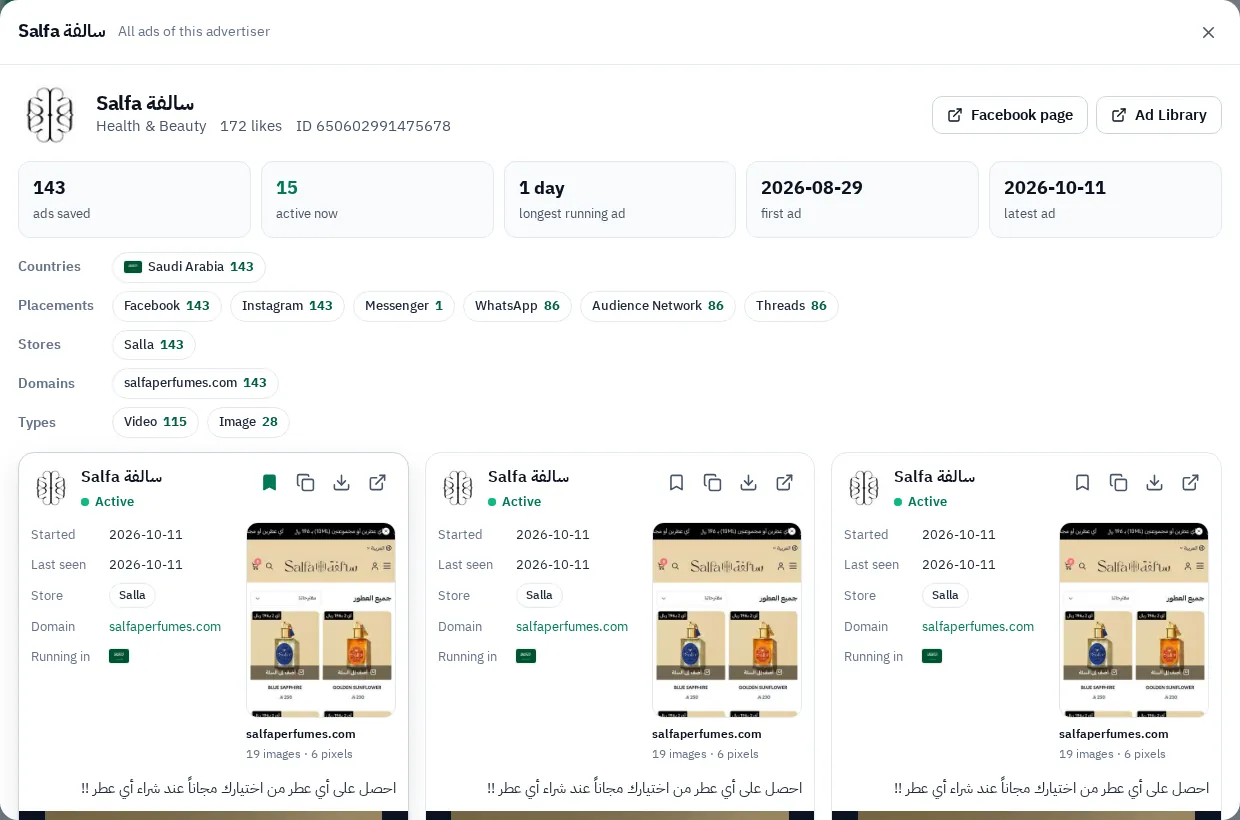
The catch: the library shows active ads only. Whatever the competitor stopped last week is gone, and it is usually what failed. In GccFY, the advertiser window shows every ad we collected from that advertiser, active and stopped, with the days each one ran.
Step 3: record the same facts from every ad
Comparisons only work when you record the same information each time. Use a simple sheet with these columns:
| Record | Why |
|---|---|
| Offer and price | A discount, "buy 2 get the 3rd free", free delivery: this is what moves buyers. |
| Angle | The problem the product solves, the audience it speaks to, or the season. |
| Format | Video, image or carousel; the video's length and its first three seconds. |
| Button | "Shop now" to a store, or "Send message" to WhatsApp. |
| Running time | The key signal: an ad running for weeks is usually profitable. |
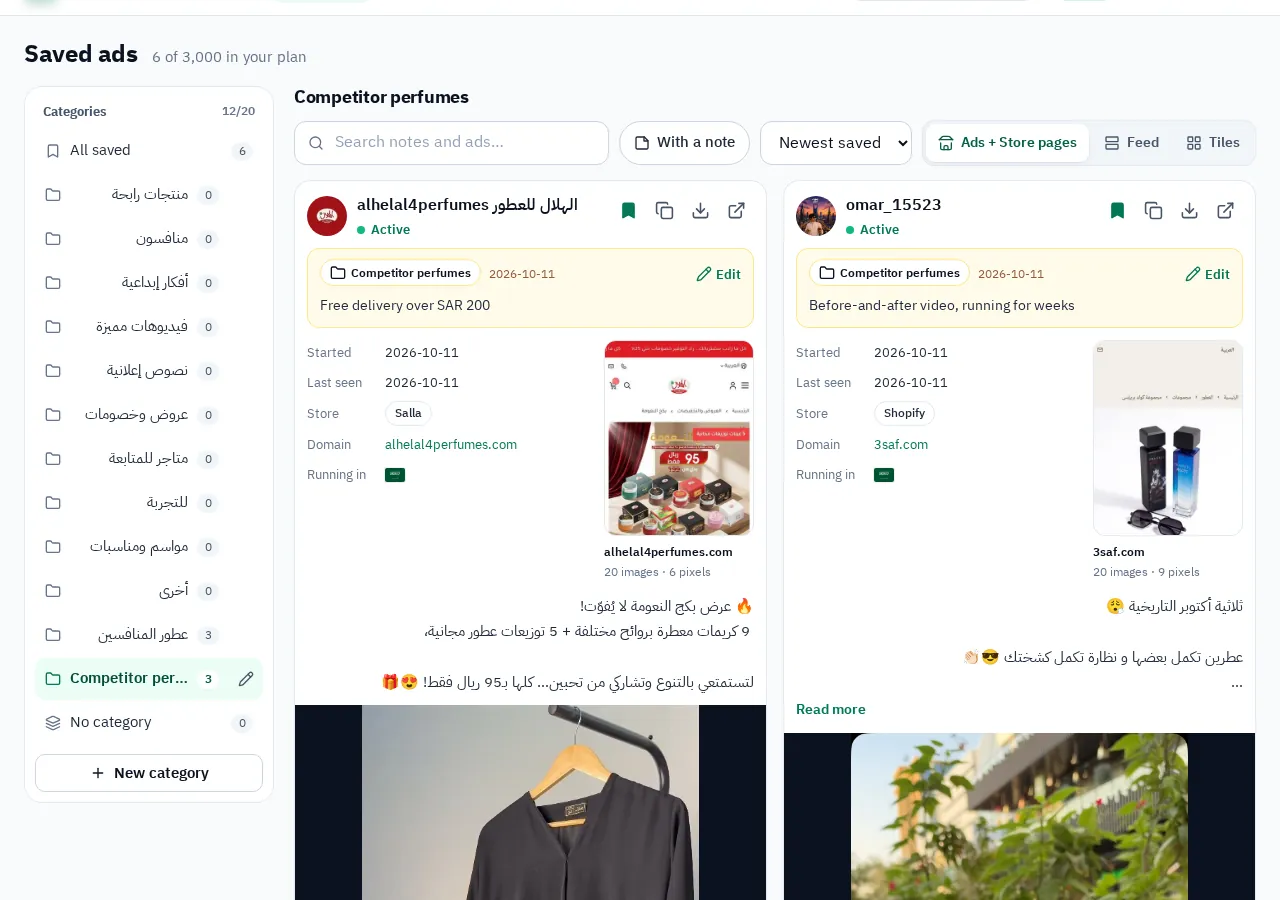
Instead of scattered screenshots, save ads into collections by competitor or angle, with a short note on each. In GccFY, the save button files the ad in the collection you choose, with your note, and keeps it after the ad stops.
Step 4: read the landing page
The ad earns the click; the landing page makes the sale. Open the link and look at:
- The price after discount and the "before" price, and whether the offer is per item or per bundle.
- Delivery: free or paid, and how many days.
- Payment: cash on delivery, pay-later with Tabby or Tamara, or card only. In our study, 11% of Arabic ads mention cash on delivery in the ad copy itself.
- Trust: reviews, return policy, contact options.
- Upsells: quantity offers and add-ons in the cart.
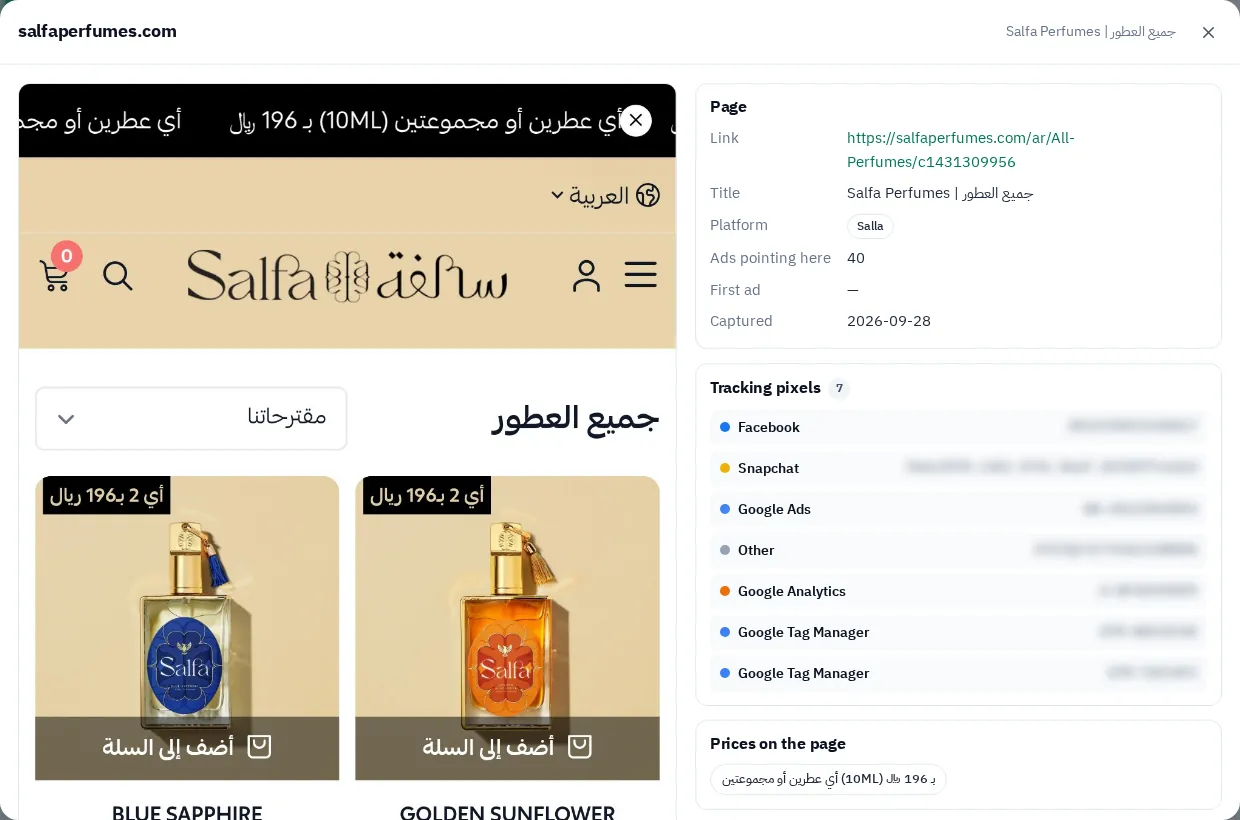
Landing pages change: prices go up, offers end, pages disappear. That is why GccFY keeps a snapshot of the store page behind every ad, so you see the page as it was when the ad ran.
Step 5: turn your notes into tests
- Do not copy the ad: images, videos and copy belong to their owners. Take the idea and the angle and make your own material.
- Test three angles: the competitor's winning angle, an opposite angle, and one built on your own strength (better price, faster delivery or a longer guarantee).
- Change one thing at a time: the offer, the video opening or the button, so you know what made the difference.
- Give ads time: do not judge after one day. Compare once each ad has enough impressions.
A 30-minute weekly routine
- 10 minutes: open your competitor list and look for ads that started since last week.
- 10 minutes: sort by running time and note the ads past two weeks.
- 5 minutes: open two landing pages and compare price and offer with yours.
- 5 minutes: write one test idea for next week.
Before the big seasons (Ramadan, Eid, national days and White Friday) make it daily, because offers change fast. See Gulf ad seasons for the dates.
Common mistakes
- Judging an ad on day one: a new ad has proven nothing yet, and most ads stop within days.
- Ignoring the landing page: many ads win on offer and price, not design.
- Following one competitor: ten advertisers reveal the pattern; one ad can be luck.
- Forgetting the country: an offer that works in the UAE may not work in Saudi Arabia. Keep notes per country.
Start from the market you sell in: Saudi Arabia ads, UAE ads, Kuwait ads, or the Gulf ads report.