In this article
Key takeaways
- A discount or an offer in 38% of Gulf ads: the first angle, but the least distinctive because everyone uses it.
- Urgency in 18%, cash on delivery in 17%, a gift in only 10%: the gift is a rare hook that gets noticed.
- The median ad is 60 words: the first line carries one angle, the rest is detail after "more".
- Emojis in 77% of ads: the rule, not the exception, but they organise the line; they do not make the hook.
What the market opens its ads with
The chart gives the share of ads mentioning each promise, out of 160,000 ads. A discount or an offer first (38%), then urgency (18%), then cash on delivery (17%) and free delivery (14%), then a gift (10%) and instalments (3%). What that means for the first line: a discount is a familiar hook that has to be a clear number to work, while a gift and cash on delivery are rarer hooks that set you apart in a crowded feed. And the first line is not the place for every promise: the median ad is 60 words (Copy length and emojis), so put one angle in the first line, the second in the second, and the urgency in the last.
Hooks 1 to 10: price, scarcity and gift
Every line is our own wording, with an English gloss. Replace the brackets with your real product and offer, and never write a scarcity or a gift that does not exist.
| Angle | First line (ours) |
|---|---|
| Price | 1. «[المنتج] بـ [السعر] بدل [السعر]، والعرض لين [اليوم].» ([Product] at [price] instead of [price], until [day].) |
| Price | 2. «قطعتين من [المنتج] بـ [السعر]: الثانية شبه ببلاش.» (Two of [product] for [price]: the second is nearly free.) |
| Price | 3. «[المنتج] الأصلي بسعر واضح: [السعر] شامل التوصيل.» (The original [product] at a clear price: [price] including delivery.) |
| Price | 4. «خصم [النسبة] على كل [الفئة]، بدون كود وبدون شروط.» ([Percent] off all [category], no code, no conditions.) |
| Scarcity | 5. «باقي [العدد] قطعة من [المنتج]، وما نعيد الطلبية قبل [الشهر].» ([Number] pieces of [product] left, and no restock before [month].) |
| Scarcity | 6. «العرض ينتهي [اليوم] الساعة [الوقت]: [المنتج] بـ [السعر].» (The offer ends [day] at [time]: [product] at [price].) |
| Scarcity | 7. «آخر دفعة من [المنتج] بهالسعر، وبعدها السعر يرجع [السعر].» (The last batch of [product] at this price; after it the price goes back to [price].) |
| Gift | 8. «اطلب [المنتج] وخذ [الهدية] معه مجاناً.» (Order [product] and get [gift] with it free.) |
| Gift | 9. «هدية [المناسبة] جاهزة ومغلّفة: [المنتج] يوصل قبل [التاريخ].» (The [occasion] gift, ready and wrapped: [product] arrives before [date].) |
| Gift | 10. «قطعتين [المنتج] والثالثة هدية، لين [اليوم].» (Two of [product] and the third is a gift, until [day].) |
Notice that the price hook carries two numbers, not the word "discount" alone, and the scarcity hook carries a count or a deadline, not "hurry". Urgency appears in 18% of ads, and the Gulf buyer recognises fake urgency from having seen so much of it.
Hooks 11 to 20: cash on delivery, the question and the result
| Angle | First line (ours) |
|---|---|
| Cash on delivery | 11. «ادفع لما يوصلك: [المنتج] والدفع عند الاستلام في كل [الدولة].» (Pay when it arrives: [product] with cash on delivery across [country].) |
| Cash on delivery | 12. «شوفه بيدك قبل ما تدفع. توصيل خلال [المدة] والدفع عند الاستلام.» (See it in your hands before you pay. Delivery within [time], cash on delivery.) |
| Cash on delivery | 13. «ما عجبك؟ رجّعه. [المنتج] باستبدال مجاني ودفع عند الاستلام.» (Don't like it? Return it. [Product] with free exchange and cash on delivery.) |
| Question | 14. «تعبت من [المشكلة]؟» (Tired of [problem]?) |
| Question | 15. «وش رايك بـ[النتيجة] خلال [المدة]؟» (How about [result] within [time]?) |
| Question | 16. «ليش تدفع [السعر] وفيه [المنتج] بـ [السعر]؟» (Why pay [price] when [product] is [price]?) |
| Question | 17. «جرّبتي [المنتج] من قبل؟ هذي النسخة اللي [الفرق].» (Tried [product] before? This is the version that [difference].) |
| Result, no social proof | 18. «[النتيجة] من أول استخدام، وبدون [العناء].» ([Result] from the first use, without [hassle].) |
| Result, no social proof | 19. «[المنتج] يخلّص [المهمة] في [المدة]، بدون [الأداة أو الخطوة].» ([Product] finishes [task] in [time], without [tool or step].) |
| Result, no social proof | 20. «من [الحالة قبل] إلى [الحالة بعد] في [المدة].» (From [before] to [after] in [time].) |
Cash on delivery appears in 17% of ads, and it is really a reassurance hook: it answers "and if it never arrives?" before the question is asked, and works best in the categories where the buyer doubts quality and in the small markets (Ad offers in numbers). The question hook works when the question is about the buyer's problem, not about your product. The last group is the honest alternative to "thousands of customers tried it": a specific result and a specific time, with no number you do not own.
What the longest-running ads open with
We sorted the ads by running time and read the first line of what survived for weeks and months. Patterns that repeat, described without quoting:
- The product name and the offer in the same line: no introduction, no greeting, no "welcome to our store". What is sold and for how much.
- The price in the local currency, two numbers: a "before" and an "after", not a "special price".
- One angle: the first line is a discount or a result or a question, not all three. Payment and delivery in the second or third line.
- Cash on delivery early in the ads of Oman, Qatar and Bahrain, and typically in electronics and accessories where the buyer doubts.
- The emoji as a bullet, not decoration: one emoji at the start of a line separates it from the next, not a whole line of symbols. Emojis appear in 77% of ads, so their presence does not stand out; their order is what gets read.
- Light Gulf dialect in fashion and beauty, simple Modern Standard Arabic in tech and health.
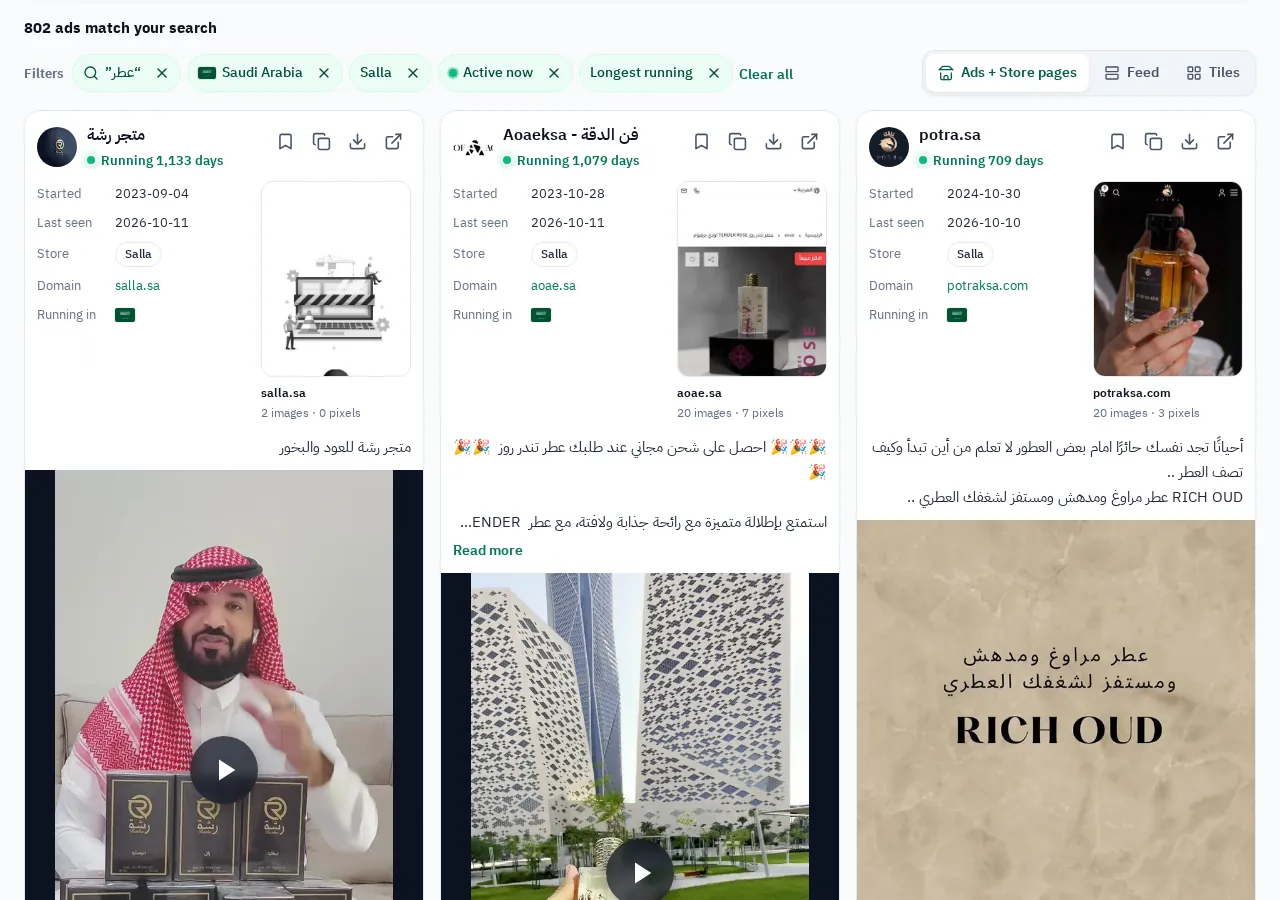
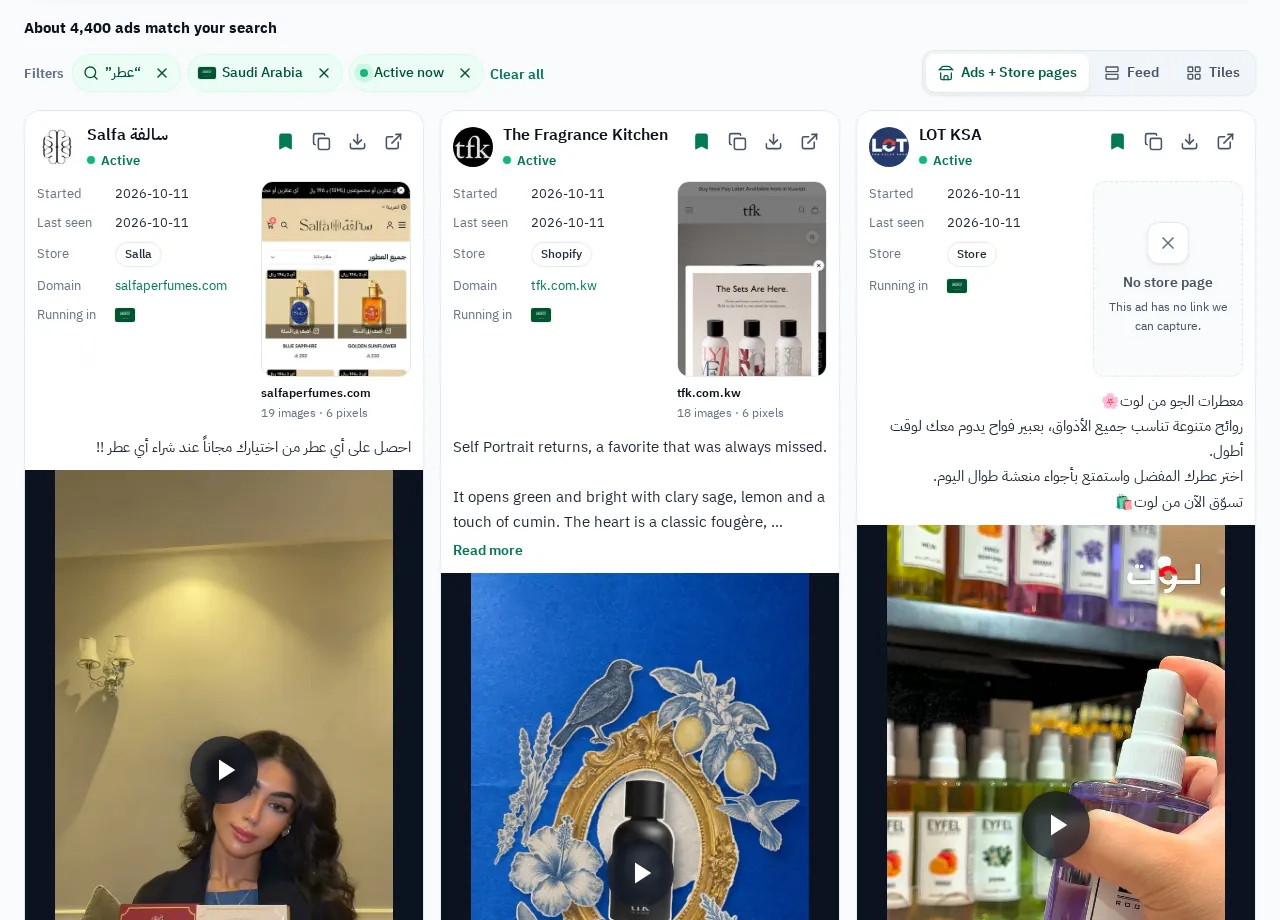
Do it yourself in your category: sort by longest running, read the first line of twenty ads, and classify its angle. You will know your category's hook before writing a word (Ad running time).
First-line mistakes
- Greetings and introductions: "welcome to our store" eats the first line with no information.
- The store name first: the reader does not know you yet; say what you sell, and keep your name in the picture and the page.
- A discount with no number: "huge discounts" is weaker than "30% off", and "30% off" is weaker than "[price] instead of [price]".
- Repeated scarcity: "last chance" every week drains the words of meaning, and can break the rules if it is false.
- Invented social proof: customer counts you do not have and reviews nobody wrote; use the specific result instead.
- Medical promises: "treats" and "cures" get the ad rejected and the store penalised (Skincare ad examples).
- Three angles in one line: a discount, a gift, free delivery and cash on delivery in one sentence, and nothing of it gets read.
- An emoji between every two words: harder to read, and no extra reach in a paid ad.
How to choose your hook and test it
- Start from your category and country: cash on delivery in the small markets and the doubted categories, the price for known brands, the gift for makeup, kids and perfume.
- Write three versions of the same ad that differ only in the first line: a price, a question, a result. The picture, the button and the rest stay fixed.
- Compare the cost per order, not per click: the question hook brings many clicks and sometimes fewer orders.
- Match the button to the hook: cash on delivery with "Order now", the price with "Shop now" (Best CTA button).
- Keep the winner for a month, then test the second line.
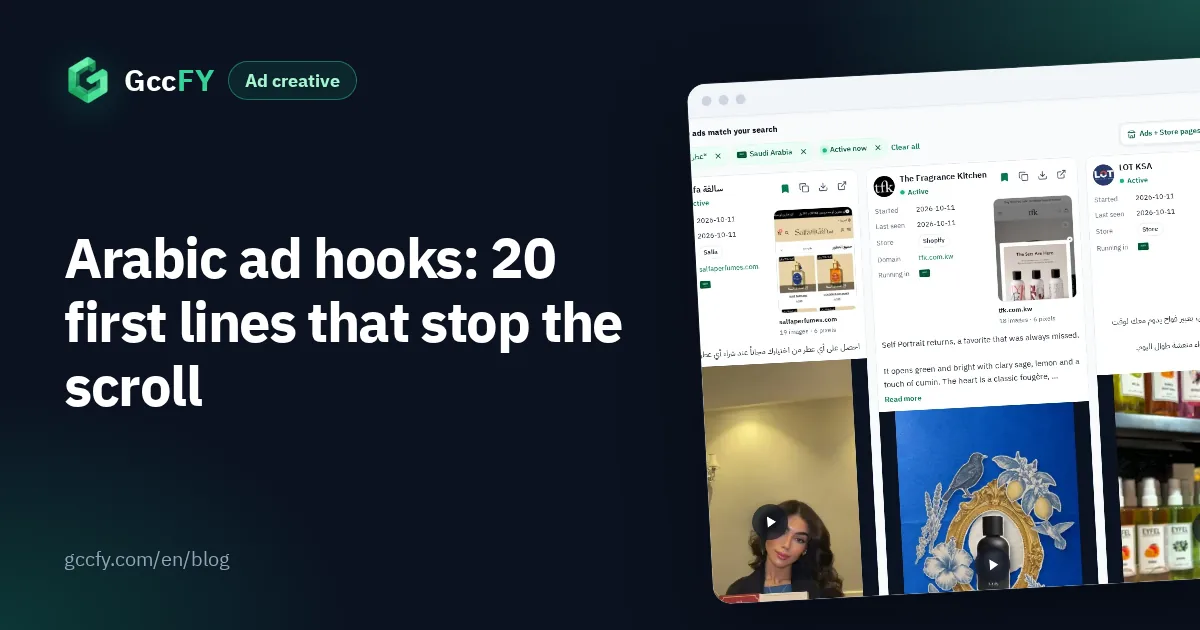
The full ad structure and the templates by category are in Arabic ad copy. In GccFY you can search ad copy for a phrase such as «الدفع عند الاستلام» (cash on delivery) or «هدية» (gift) and sort by running time, to see how those who succeeded open with it.