What Gulf ads offer: cash on delivery, free delivery and discounts, in numbers
Every winning ad in the Gulf carries a promise in its first line: a discount, cash on delivery, free delivery, or "limited quantity". We read the newest 160,000 Arabic ads in the library and counted every promise: how often it is mentioned, in which country, in which category. This is the map of the offers the market uses, so you know what to write and when.
A discount or an offer in 38% of the ads: the first promise in the Gulf.
Urgency ("hurry", "limited time") in 18%, cash on delivery in 16%, free delivery in 12%.
A gift in 10%, instalments (Tabby, Tamara) in only 3%, WhatsApp in the text in 11%.
Cash on delivery doubles from Saudi Arabia (12%) to Oman (26%), and jumps in accessories and electronics.
The six promises
What the ads offer in the Gulf
The share of ads mentioning each offer, of 160,000 ads (GccFY's third study, 2026-11-03: the newest 160,000 Arabic ads of the library).
Video69%111,043
A discount or an offer38%61,328
Limited offer / hurry18%29,560
Cash on delivery16%25,295
Free delivery12%19,785
WhatsApp in the text11%16,822
A gift10%15,257
Instalments (Tabby, Tamara)3%4,896
The chart gives the share of ads mentioning each promise, out of 160,000 ads. The discount first by a margin: the Gulf market is used to an offer in every ad. Urgency second, then cash on delivery and free delivery with close shares. Gifts and instalments are far lower, and therefore an opportunity: a rare promise sets you apart.
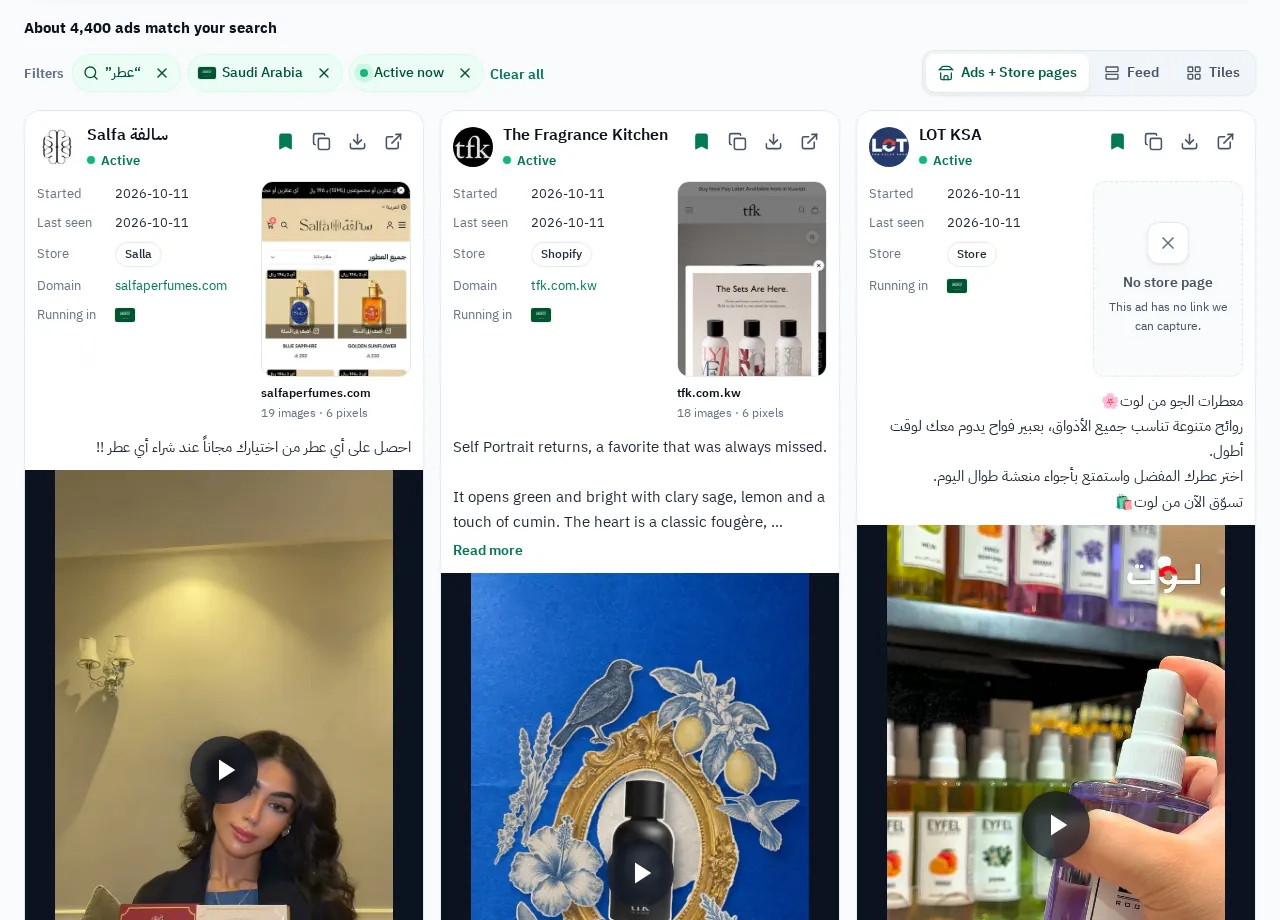
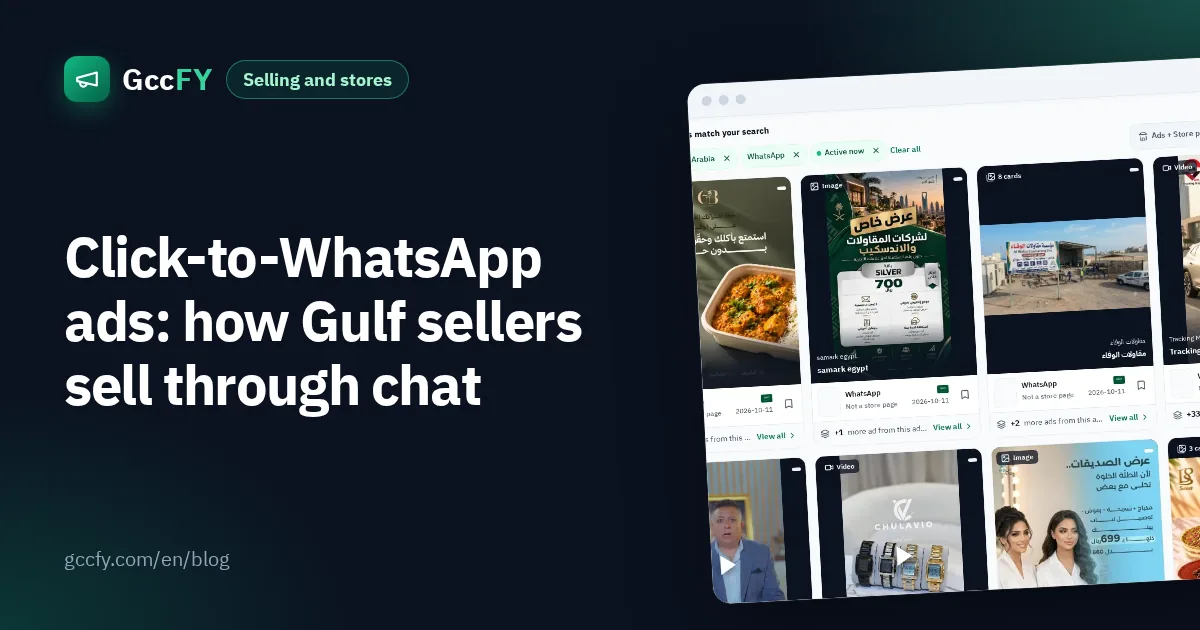
Ad cards in GccFY: the text, the offer and the price, and the store page behind each ad.
Each country has its promise
Cash on delivery: Saudi Arabia 12%, the UAE 14%, Kuwait 13%, Qatar 17%, Bahrain 18%, Oman 26%. The smaller the market or the lower the trust in online payment, the higher the share. Free delivery is highest in Bahrain (16%), Oman (17%) and Qatar (13%): in fast-delivery countries the customer expects free. Discounts are highest in Oman (46%) and the UAE (40%). Instalments are Saudi-Emirati (4% and 4%) and nearly absent elsewhere.
What the ads offer in Saudi Arabia
The share of ads mentioning each offer, of 56,619 ads (GccFY's third study, 2026-11-03: the newest 160,000 Arabic ads of the library).
Video63%35,494
A discount or an offer34%19,381
Limited offer / hurry16%8,837
Cash on delivery12%6,528
Free delivery10%5,926
WhatsApp in the text9%5,368
A gift8%4,619
Instalments (Tabby, Tamara)4%2,520
What the ads offer in Oman
The share of ads mentioning each offer, of 21,621 ads (GccFY's third study, 2026-11-03: the newest 160,000 Arabic ads of the library).
Video77%16,728
A discount or an offer46%9,925
Cash on delivery26%5,629
Limited offer / hurry24%5,260
Free delivery17%3,575
A gift13%2,793
WhatsApp in the text10%2,086
Instalments (Tabby, Tamara)1%300
Each category has its promise
Cash on delivery jumps in the categories where the buyer doubts quality: accessories 43%, electronics 36%, health 29%, fashion 27%; and drops in food (13%) and perfumes (14%) where the brand sells. The gift is the weapon of makeup (30%), kids (23%) and accessories (25%). Discounts peak in accessories (63%) and fashion (53%).
What the ads offer in watches and accessories ads
The share of ads mentioning each offer, of 16,800 ads (GccFY's third study, 2026-11-03: the newest 160,000 Arabic ads of the library).
Video87%14,582
A discount or an offer63%10,629
Cash on delivery43%7,304
Free delivery35%5,955
Limited offer / hurry29%4,795
A gift25%4,201
WhatsApp in the text4%734
Instalments (Tabby, Tamara)2%273
What the ads offer in food, coffee and dates ads
The share of ads mentioning each offer, of 9,673 ads (GccFY's third study, 2026-11-03: the newest 160,000 Arabic ads of the library).
Video70%6,735
A discount or an offer42%4,109
Limited offer / hurry19%1,806
Cash on delivery13%1,279
A gift13%1,249
WhatsApp in the text11%1,079
Free delivery8%728
Instalments (Tabby, Tamara)3%308
The button
The ads' buttons in the Gulf
The call-to-action button of 160,000 ads (GccFY's third study, 2026-11-03: the newest 160,000 Arabic ads of the library).
Shop now42%67,556
WhatsApp message26%41,447
Order now14%23,186
See details3%4,998
Send message3%4,805
Learn more3%4,114
"Shop now" for stores, "WhatsApp message" for selling by chat, "Order now" for single-product pages. The button should match the promise: cash on delivery with "Order now", a discount with "Shop now". WhatsApp ads.
What to write in your ad
One promise in the first line, the one that fits your country and category from the tables above. In Oman and Qatar: cash on delivery. In Saudi Arabia and the UAE for a known brand: the discount or instalments.
A second promise in the second line: free delivery or a gift.
Urgency in the last line, honestly: a date or a quantity.
The price written in the local currency; an ad that hides the price loses the unserious clicks and wins them at the same time.
Test the promise, not the picture: the same ad with "cash on delivery" then with "free delivery", a week each, and watch the longest-running ads of your competitors in the library.
The GccFY teamThe GccFY team follows Arabic ads in the six Gulf markets every day and writes these articles from the library's data and sellers' experience.
Frequently asked questions
What is the most common offer in Gulf ads?
A discount or an offer: 38% of the ads. Then urgency (18%), cash on delivery (16%) and free delivery (12%).
In which country does cash on delivery matter most?
Oman (26%), then Qatar (17%) and Bahrain (18%); the least in Saudi Arabia (12%).
Are instalments common in Gulf ads?
No: only 3%, nearly confined to Saudi Arabia and the UAE. Which makes them an opportunity for goods above a few hundred riyals.
Should I write the discount or cash on delivery?
By country and category: cash on delivery for the small markets and the categories where the buyer doubts (accessories, devices), the discount for Saudi Arabia, the UAE and known brands. Test both.
Where do these numbers come from?
From the newest 160,000 Arabic ads in GccFY's library between 2026-10-24 and 2026-11-03, by counting the words in every ad's text.