In this article
Key takeaways
- In Shopify the Meta pixel is connected through the Facebook & Instagram sales channel (the Meta app), or through "Customer events" for a custom pixel; TikTok and Snapchat each have a Shopify app.
- The gap is Snapchat and TikTok: the Snapchat pixel is on 49% of Shopify stores against 82% of Salla stores, TikTok on 53% against 85%. A Saudi store on Shopify usually needs both, but has to install them itself.
- Saudi Shopify stores sell skincare and fashion first (11% and 10%), at a median price of SAR 199, with catalogue ads in 24% of their ads.
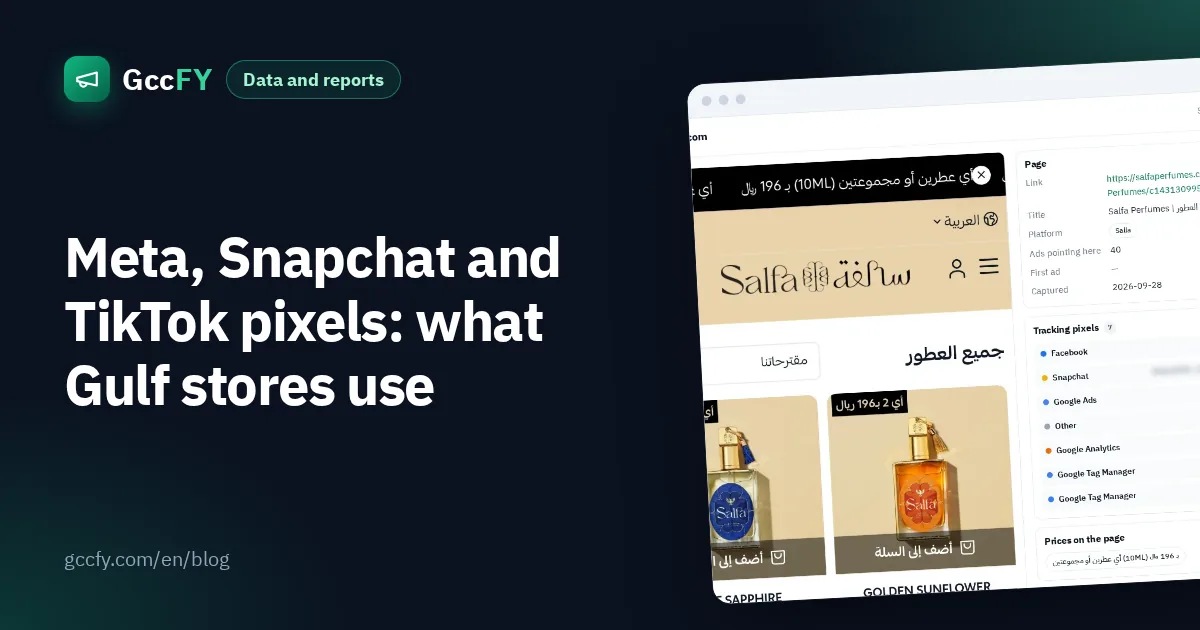
- The pixel filter in GccFY shows the ads of Saudi Shopify stores carrying a given pixel, and the store page window shows each store's pixels.
Why the pixel on Shopify differs from Salla
A pixel is a small piece of an ad platform's code on your store pages that sends it events: a product view, an add to cart, a checkout started, a purchase. With them the platform learns who buys and shows your ad to similar people, retargets those who did not finish, and works out your cost per order. Without a pixel you pay for ads that teach the platform nothing.
Salla and Zid stores connect the Meta, TikTok, Snapchat and Google pixels from the store dashboard, which is why the vast majority of them carry them. On Shopify the connection goes through the sales channel and the official apps, one extra step per platform, and that is the reason for the gap you will see in the numbers. Saudi Arabia is a strong Snapchat and TikTok market, so a Saudi store on Shopify that stops at Meta leaves two channels to its Salla competitors. The general guide to all three platforms is in Salla, Zid and Shopify pixels.
How to install the Meta, TikTok and Snapchat pixels in Shopify
The documented path for each platform, in general words; the exact steps change with updates, so follow Shopify's current help centre:
- The Meta pixel (Facebook and Instagram): in the Shopify admin, the Facebook & Instagram sales channel (the Meta app) connects your store to your ad account and links the pixel and dataset, so the store's events are sent automatically.
- A custom pixel: if you need your own code, Shopify offers Customer events for adding a custom pixel instead of pasting code into the theme.
- The TikTok pixel: TikTok has a Shopify app that installs its pixel and sends the events.
- The Snapchat pixel: Snapchat also has a Shopify app that installs its pixel.
- Verify: open each platform's events manager, visit your store, add a product to cart and complete a test order if you can, and make sure the events reached the right account. The Meta Pixel Helper, TikTok Pixel Helper and Snap Pixel Helper extensions in Chrome help.
- Do not install a pixel twice: the channel or app plus manual code for the same pixel doubles the purchase count.
And install only what you actually advertise on: every extra pixel slows the page a little for nothing.
Shopify against Salla and Zid on pixels
In our second study (October 2026) we checked the latest snapshot of 30,000 store pages that Gulf ads lead to, and counted the pixels on each platform's store pages (the numbers are for each platform's stores across the whole Gulf, not Saudi Arabia alone):
| Pixel | Shopify | Salla | Zid |
|---|---|---|---|
| Meta (Facebook and Instagram) | 92% | 93% | 93% |
| TikTok | 53% | 85% | 88% |
| Snapchat | 49% | 82% | 83% |
| Google Ads | 47% | 56% | 53% |
| Google Analytics | 62% | 92% | 81% |
The Meta pixel is almost universal on all three. The gap is Snapchat and TikTok: only about half of Shopify stores, against the vast majority of Saudi Salla and Zid stores. Part of the difference is that Shopify stores spread across the UAE and Kuwait, where Snapchat and TikTok are less central, but a store selling to Saudis on Shopify competes with Salla stores advertising on all three channels. The full study is in Tracking pixels in Gulf stores.
What Shopify stores in Saudi Arabia advertise
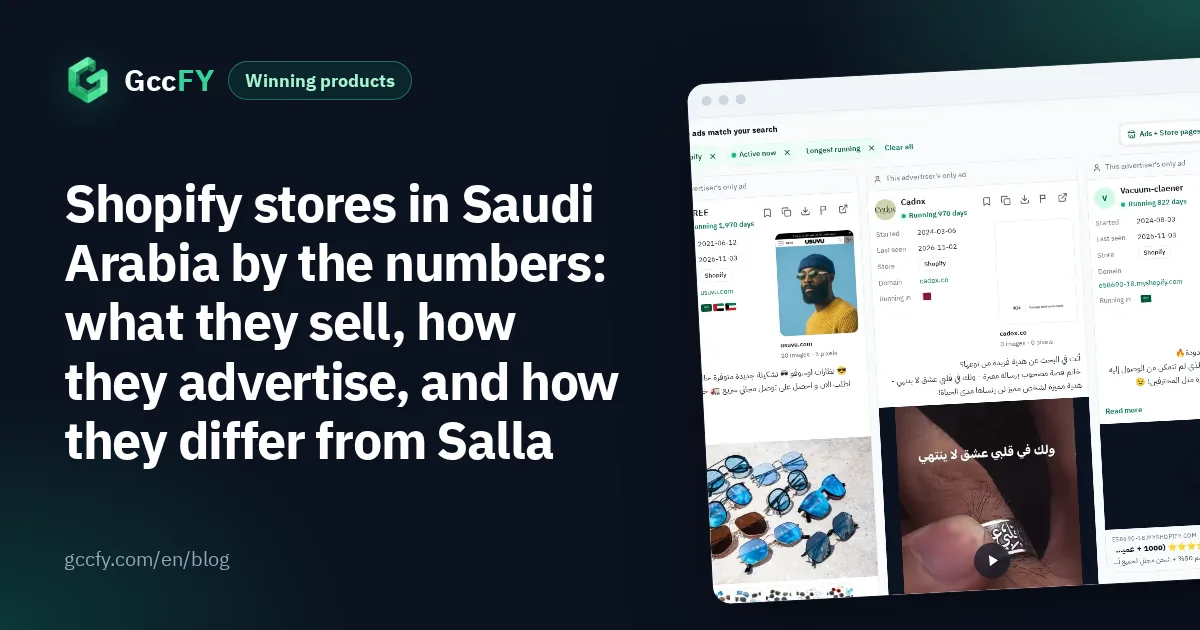
Across 4,391 ads of Shopify stores shown in Saudi Arabia: skincare (11%) and fashion (10%) first, then health (8%), perfumes (7%), hair and electronics (6% and 6%). Many are brands selling in more than one Gulf country, one of the reasons they chose Shopify.
The median advertised price is SAR 199, with the middle half between SAR 99 and 250. A discount or an offer in 40%, free delivery in 18%, cash on delivery in 9% (against 12% of all Saudi ads), instalments in 4%. The part that matters for the pixel: catalogue (dynamic) ads make up 24% of Saudi Shopify ads, and they only work with a pixel and a catalogue connected to Meta. The button is "Shop now" on 65% and "Order now" on 23%. The full comparison with Saudi Salla stores is in Shopify stores in Saudi Arabia.
The GccFY pixel filter: who advertises where in Saudi Arabia
- In the library: pick Saudi Arabia and the "Shopify" store type, then the pixel filter, and sort by longest running: the ads of Saudi stores on Shopify carrying the pixel you chose, the oldest running first.
- On the Domains screen: set the platform to Shopify and the pixel to Snapchat or TikTok, and you get the stores set up for that platform's ads, with their ads per country.
- Open the store page behind any ad: the store page window shows the page snapshot and the tracking tools we found on it.
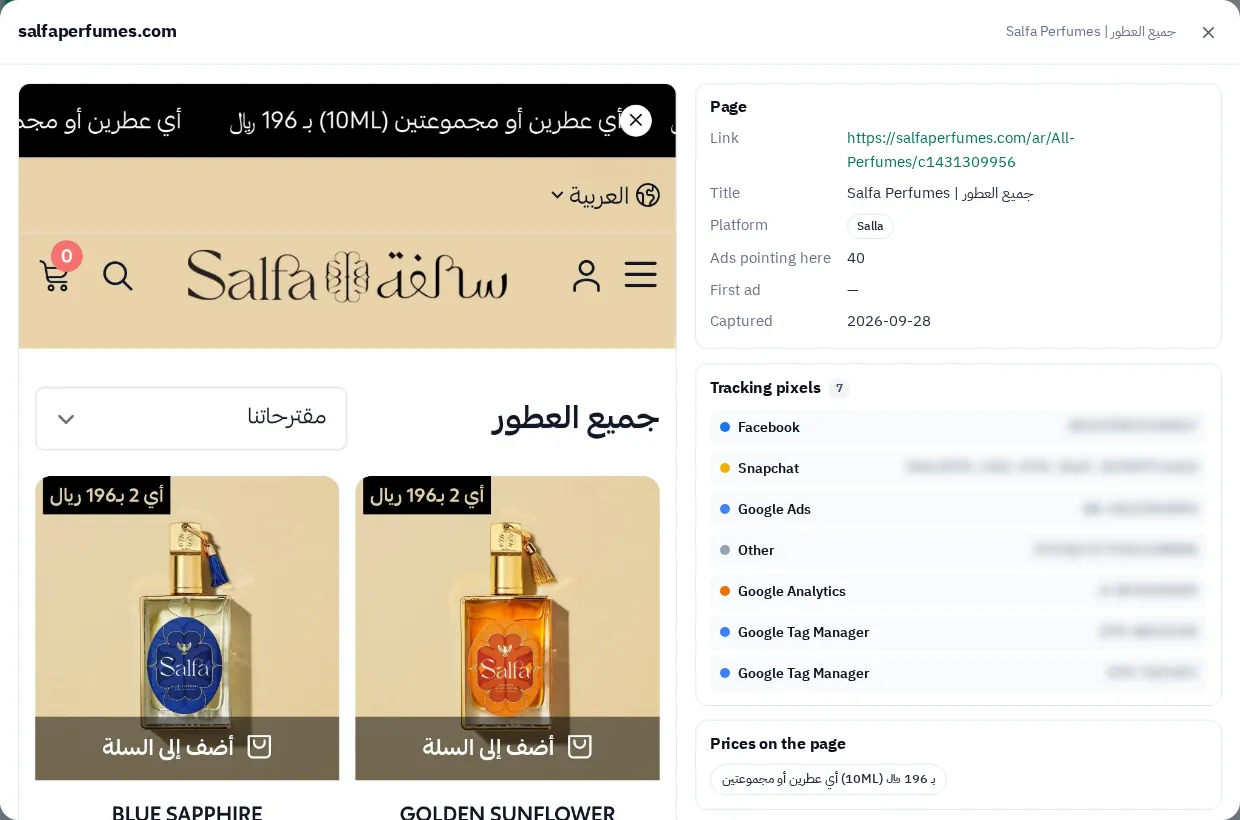
Do the same with the "Salla" filter to see what your competitors on the other platform carry. The information is public and legitimate: the pixel is in the page code that reaches any visitor, and you never try to access anyone's accounts. For a Kuwaiti store on Shopify there is a matching guide with Kuwait's numbers: Shopify pixel in Kuwait.
Common Shopify pixel mistakes in Saudi Arabia
- Meta alone in a Snapchat and TikTok market: if your audience is Saudi, your Salla competitors advertise on all three channels; check them before you decide.
- Launching before connecting: days of ads without purchase events are days lost for the platform's learning.
- The pixel twice: the channel or app plus manual code for the same pixel.
- Forgetting the purchase event: verify that the purchase arrives, not just the page view.
- The wrong account: after connecting, confirm in the events manager that events reach the right dataset.