In this article
Key takeaways
- In Saudi Arabia the middle half of written prices runs from SAR 99 to 300 with a median of 196; in the UAE the median is AED 299 and the upper quarter 600.
- In Kuwait the median is KWD 20, in Bahrain BHD 22, in Oman OMR 20: each country in its own currency, never compare the columns with each other.
- The priciest categories by median in riyals: abayas (250), home and furniture (224) and electronics (200); the cheapest are fashion (69) and hair care (99).
- A price written in an ad is not a selling price: only 7% of ads state one, and it is usually the offer price or a "from" price. Use it as a lane, not a fact.
Prices by country, each in its own currency
| Country | Currency | Lower quarter | Median | Upper quarter | Ads with a written price | Share of the country's ads |
|---|---|---|---|---|---|---|
| Saudi Arabia | SAR | 99 | 196 | 300 | 7,414 | 13% |
| UAE | AED | 130 | 299 | 600 | 5,251 | 13% |
| Kuwait | KWD | 12 | 20 | 46 | 2,295 | 8% |
| Qatar | QAR | 100 | 211 | 499 | 2,062 | 9% |
| Bahrain | BHD | 12 | 22 | 50 | 1,010 | 6% |
| Oman | OMR | 14 | 20 | 40 | 2,549 | 12% |
Every row is in its own currency as written in the ad, and we converted nothing: the Kuwaiti and Bahraini dinars and the Omani riyal are large units, so their numbers are small and cannot be set against Saudi riyals or dirhams. Read each country on its own. Inside each currency, one thing stands out: the UAE has a wider range than Saudi Arabia, with an upper quarter of AED 600 against a lower quarter of 130, so the Emirati market carries expensive goods next to cheap ones more than the others. In Saudi Arabia a price appears in 13% of ads and in Oman in 12%, while in Bahrain it is only 6%: the less a market writes prices, the more it relies on the message and the store to reveal them.
Prices by category, in Saudi riyals
Category prices are counted across the whole Gulf and converted to Saudi riyals so they can sit in one table:
| Category | Lower quarter (SAR) | Median (SAR) | Upper quarter (SAR) | Ads with a written price | Share of the category's ads |
|---|---|---|---|---|---|
| Perfumes and incense | 60 | 189 | 229 | 1,156 | 9% |
| Abayas | 75 | 250 | 320 | 276 | 11% |
| Skincare | 99 | 199 | 310 | 534 | 4% |
| Makeup | 99 | 149 | 200 | 148 | 2% |
| Hair care | 50 | 99 | 199 | 840 | 5% |
| Home and furniture | 99 | 224 | 500 | 760 | 6% |
| Kids and toys | 50 | 100 | 450 | 445 | 5% |
| Food, coffee and dates | 90 | 175 | 359 | 726 | 8% |
| Watches and accessories | 99 | 199 | 199 | 941 | 5% |
| Electronics | 99 | 200 | 450 | 1,476 | 8% |
| Fashion and shoes | 50 | 69 | 200 | 829 | 4% |
| Health and supplements | 78 | 169 | 299 | 737 | 5% |
Three patterns in the table. Narrow categories whose market settled on a price point: watches and accessories have the same number as median and upper quarter (SAR 199), perfumes run from 60 to 229, makeup from 99 to 200. Wide categories that mix cheap and expensive in one name: home and furniture from 99 to 500, kids from 50 to 450, electronics from 99 to 450; there the category median is not enough and you need the prices of your specific product. Cheap categories that compete on price: fashion with a median of SAR 69 and hair care at 99, both heavy on discounts (53% and 55% of their ads). What each category advertises most: Best sellers in Saudi Arabia.
How to read the lower quarter, the median and the upper quarter
Sort every written price in a category from cheapest to dearest. The lower quarter is the price a quarter of the ads sit below, the median the price half of them sit below, and the upper quarter the price three quarters sit below. Between the two quarters lies the "middle half": the lane most of the market's prices run in. In Saudi Arabia, for example: a quarter of the priced ads are below SAR 99, half are below 196, and a quarter are above 300.
- Your price below the lower quarter: you are in the cheapest quarter of the market. It suits volume and cash on delivery, and the margin gets thin after ad and delivery costs.
- Your price near the median: the buyer is not surprised by it, and you compete on the picture and the offer, not the number.
- Your price above the upper quarter: you need a visible reason in the ad: a brand, gift packaging, a guarantee, or instalments. Perfumes are the example: 18% of their ads mention a gift, which is what justifies the higher price.
And remember that the discount is part of the price in the Gulf: 38% of ads mention a discount or an offer, so the written price is often an "after discount" price. All the offers in detail: Ad offers in numbers.
A pricing routine on the longest-running ads
The two tables give you the lane. The longest-running ads give you the point inside it, because an ad that stayed up for weeks with a written price is an ad its owner kept paying for, and that is the closest available signal that the price is accepted (a signal, not proof).
- Set the lane: your category's median from the table, then your country from the country table.
- Search your exact product: in GccFY type the product word the way sellers write it ("دهن عود" oud oil, "سيروم" serum, "طقم قهوة" coffee set) with your country filter, keep active ads, and sort by longest running.
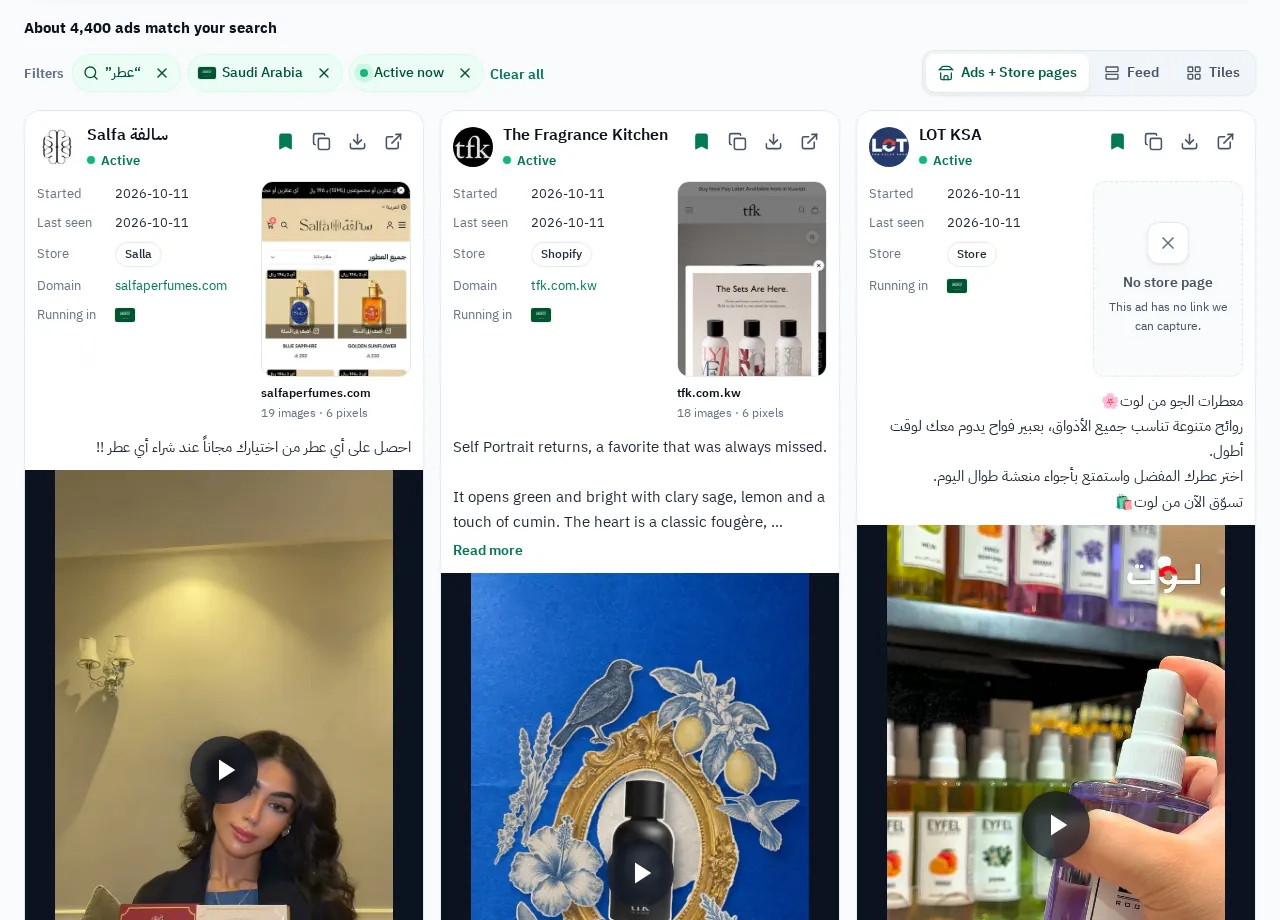
- Read ten prices: the price on the card, then the price on the captured store page behind the ad; note both, since the ad price may be an offer price and the store price the regular one.
- Place yourself: a comparable product with no edge: at the median of the ten. A visible edge (brand, guarantee, gift): above it. Competing on volume: at the lower quarter, with cash on delivery.
- Write the price in the ad in the local currency, as one number rather than "from" where you can: an ad that states its price loses the unserious clicks and keeps the serious ones.
- Test two prices: the same ad at two prices, a week each, and compare cost per order, not per click.
- Come back monthly: written prices move with seasons and discounts, and the library keeps the old ads so you can compare.

Long-running ads also need careful reading: how to compare competitor ads and how many words they write.
What these numbers do not say
- Written prices, not selling prices. The number is taken from the ad text as the advertiser wrote it. We do not know what they actually sold at, how much they sold, or whether the price includes delivery or tax.
- A minority of ads. Only 7% of ads state a price (10,916 of 160,000). The rest leave the price to the store or to a WhatsApp chat; across the Gulf 10% of ads mention WhatsApp in their text.
- Usually the offer price. "199 instead of 350" counts as 199. Sets and "two for" offers enter at the set price.
- A category mixes different products. A lipstick and a lighted mirror in makeup, a table and a tablecloth in home. The category median is a compass; your specific product's price comes from step three of the routine.
- Small samples in some cells. Bahrain has only 1,010 priced ads and makeup 148; read those numbers as rough bounds.
- No currency conversion. Each country in its own currency; we did not convert and do not advise converting to compare: a Kuwaiti buyer does not compare in riyals.
See the prices in your competitors' ads
- Open the library, type your product word, pick the country and active ads.
- Sort by longest running and read the prices on the cards.
- Open the captured store page behind the ad: the actual store price, the payment method, the delivery.
- Save ten ads in a collection named after your product with a price note, and return to it before every change to your price.