In this article
Key takeaways
- The fastest way: the Wappalyzer or BuiltWith browser extension reveals the platform as soon as you open the store.
- Without extensions: search the page source for the platform's name, and look at the checkout page, which many platforms keep the same across their stores.
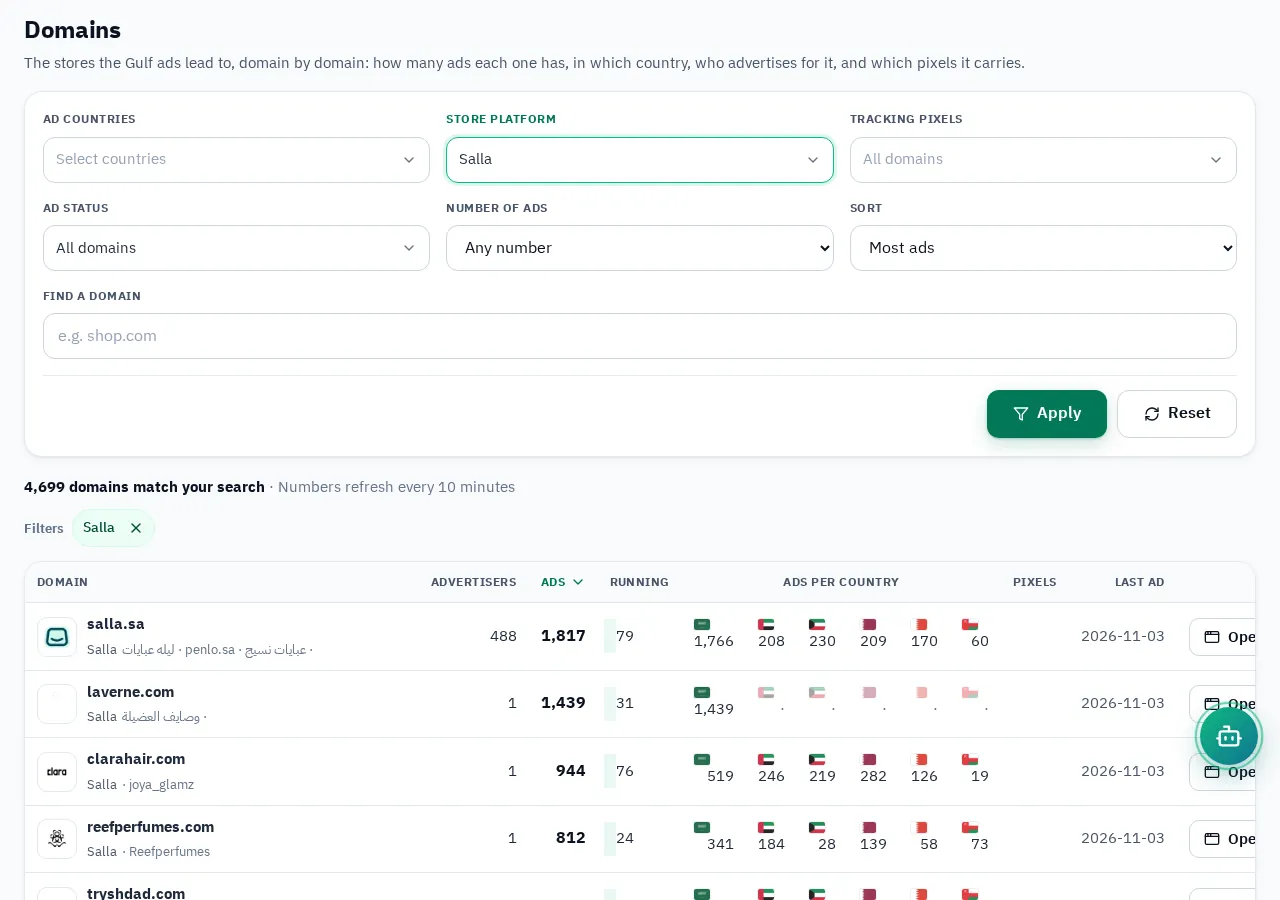
- In GccFY the platform is written on every ad card and on each store's row in the Domains screen, and you can filter ads and stores by it.
- WhatsApp with no store takes 27% of Gulf ads, then Shopify 9% and Salla 8%; in Saudi Arabia Salla has 20% of the ads.
Why a store's platform matters
The platform reveals how a store sells before you open a product. Take cash on delivery: YouCan store ads mention it in 26% of cases, EasyOrders 21% and LightFunnels 21%, against only 1% on Salla and 8% on Shopify. A competitor on YouCan usually sells with payment at the door to a buyer who does not know it; a competitor on Salla sells with online payment and instalments to a buyer who trusts the store.
The platform also sets how you study the store: Shopify reveals a lot on many of its stores, the rest need the general methods. The full guide per platform: Spy on any online store.
Way 1: a browser extension (the fastest)
Install the Wappalyzer or BuiltWith extension in Chrome, open the store and click its icon. It shows the platform, and sometimes other tools on the site: the payment gateway, analytics, pixels. For tracking tools specifically there is the Meta Pixel Helper extension, which shows the Meta pixel on the page (Salla, Zid and Shopify pixels).
A warning: extensions rely on known fingerprints, so they can be wrong or miss a local platform or a custom store. If they say nothing, move to the second way.
Ways 2 and 3: the page source and the checkout page
- The page source: open "View page source" (Ctrl+U in Chrome on a computer), then search with Ctrl+F for the platform's name. Shopify stores, for example, name their theme in the source (Shopify.theme), and other platforms often leave their name in the addresses of their files.
- The checkout page: add a product to the cart and go on to checkout without completing the order. Hosted platforms keep this page looking the same across their stores, so after a few stores you will know the look at a glance.
- No store at all: if the ad's button is "Send WhatsApp message" and its link is API.WHATSAPP.COM, the seller sells in the chat and has no platform. Studying them is different: Spy on WhatsApp sellers.
Never complete a fake order to learn something: the checkout page tells you enough before the order step.
Way 4: GccFY writes the platform on every ad
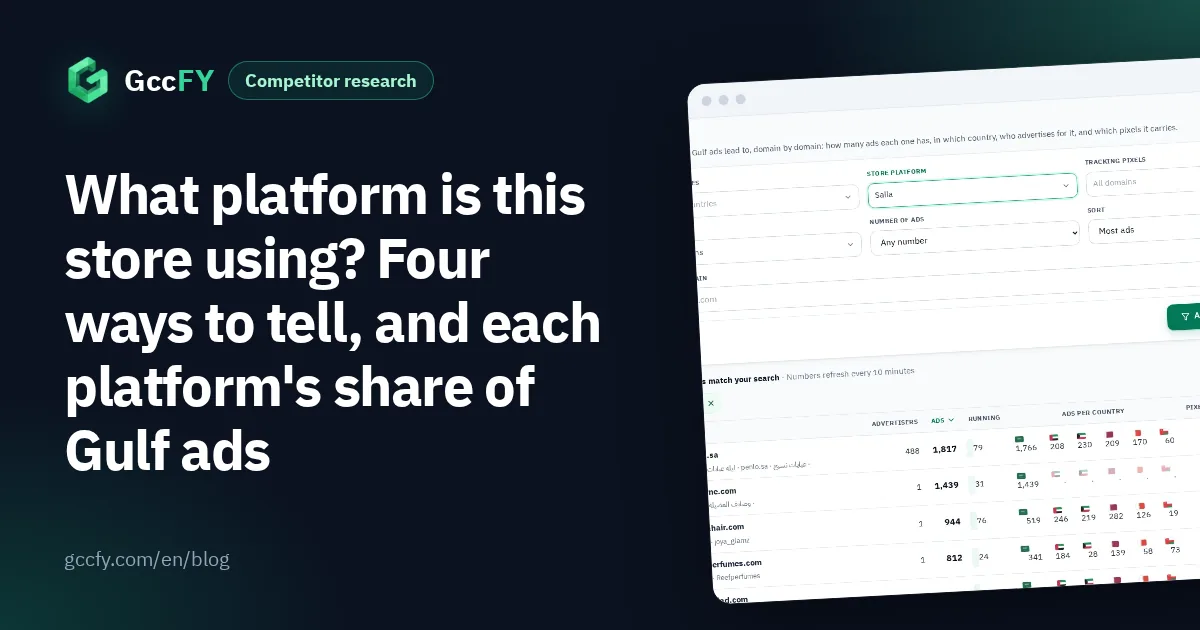
In GccFY we read the link of every ad and identified the store platform behind it: Salla, Zid, Shopify, YouCan, WooCommerce, EasyOrders, LightFunnels, or WhatsApp with no store. The platform is written on the ad card, and on the Domains screen for each store along with its ads in every country. It works the other way round too: filter the library or the Domains screen by platform to see all of its stores.
Looking for Shopify stores in Saudi Arabia and the Gulf specifically? Find Shopify stores in the Gulf.
Each platform's share of Gulf ads
Of the ads whose destination we identified, WhatsApp with no store comes first (27% of the newest 160,000 ads), then Shopify (9%) and Salla (8%), then LightFunnels (2%), and after it WooCommerce, Zid, EasyOrders and YouCan with small, similar shares.
But the map changes by country: in Saudi Arabia Salla has 20% of the ads and Shopify 8%; in the UAE Shopify has 13% and Salla 1%; in Kuwait Shopify has 14%. A Saudi store on Shopify or an Emirati store on Salla is an exception worth asking about. The full comparison of platforms: Salla, Zid and Shopify.
What the platform tells you about a competitor
| Platform | What it usually means | Cash on delivery in its ads | Video |
|---|---|---|---|
| Salla | A Saudi platform, online payment and instalments built in | 1% | 59% |
| Zid | Also a Saudi platform, in the same style | <1% | 56% |
| Shopify | A store selling across the Gulf, strongest outside Saudi Arabia | 8% | 56% |
| WooCommerce | The WordPress store plugin, spread across the Gulf | 9% | 62% |
| YouCan | Moroccan-founded, popular with cash-on-delivery stores | 26% | 75% |
| EasyOrders | Popular with cash-on-delivery stores in Egypt and the Gulf | 21% | 83% |
| LightFunnels | One-product pages for dropshipping | 21% | 82% |
The platform is a starting point, not a verdict: a Salla store may advertise cash on delivery, and a Shopify store may be a big brand or a dropshipper. The next step is to open its ads and landing pages.