In this article
Key takeaways
- In the Google Ads Transparency Center, pick the region with the button next to the search box ("Ads in Saudi Arabia"), then search the advertiser's name or website.
- Every ad shows the regions it ran in and when it was last shown, so you know whether the competitor advertises in a given country.
- The tool shows neither keywords nor budgets, cannot search by product, and the country an advertiser is based in is not the country they advertise in.
- For Facebook and Instagram ads by country: the Meta library shows what ran in a chosen country, and in GccFY every Arabic ad carries its countries; Saudi Arabia is in 35% of the newest Gulf ads.
Why normal browsing does not show Google ads in another country
A Google advertiser chooses the countries their ad runs in, and Google shows it to people browsing from those countries. Search from Kuwait for your Saudi competitor's product and their Saudi-targeted ads will not appear. Changing your location with a VPN is tiring and imprecise.
The right way is the Google Ads Transparency Center at adstransparency.google.com: a public tool that shows verified advertisers' ads across Search, YouTube, Display, Shopping and Maps, free and with no ad account, with a region filter. The general guide to the tool is Google Ads Transparency Center; here we focus on using it across countries.
The region filter, step by step
- Open adstransparency.google.com. Next to the search box is a region button; choose the country you want: "Ads in Saudi Arabia", the UAE or Kuwait.
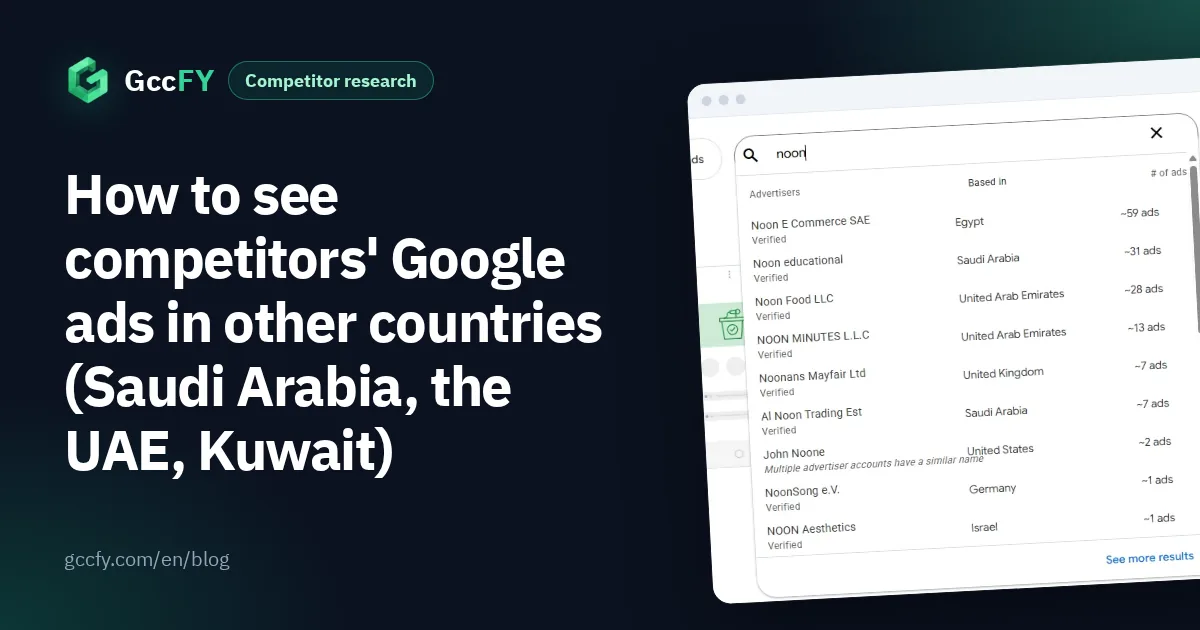
- Type the advertiser's name or website. A list of matching advertisers appears, each with the country they are based in and their number of ads.
- Pick the advertiser to open their page, then narrow with the filters for time, platform (Search, YouTube, Shopping, Maps…) and format (text, image or video).
- Open any ad to see its copy, image or video, the regions it ran in, and when it was last shown.
- Change the region and repeat the same search to compare: what the competitor shows Saudi Arabia may differ from what they show the UAE.
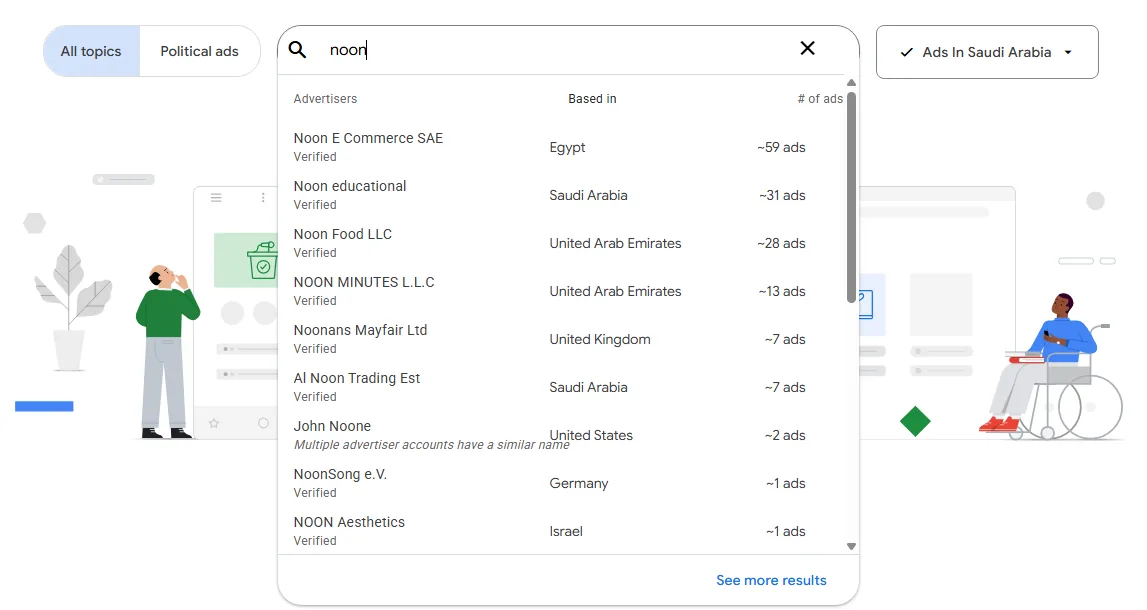
Mind the difference between two things: the advertiser's country (where the company operates) and the ad's region (where it was shown). A store based in the UAE may advertise in Saudi Arabia and Kuwait at once, and that is what the region filter and each ad's regions reveal.
What an advertiser's page tells you
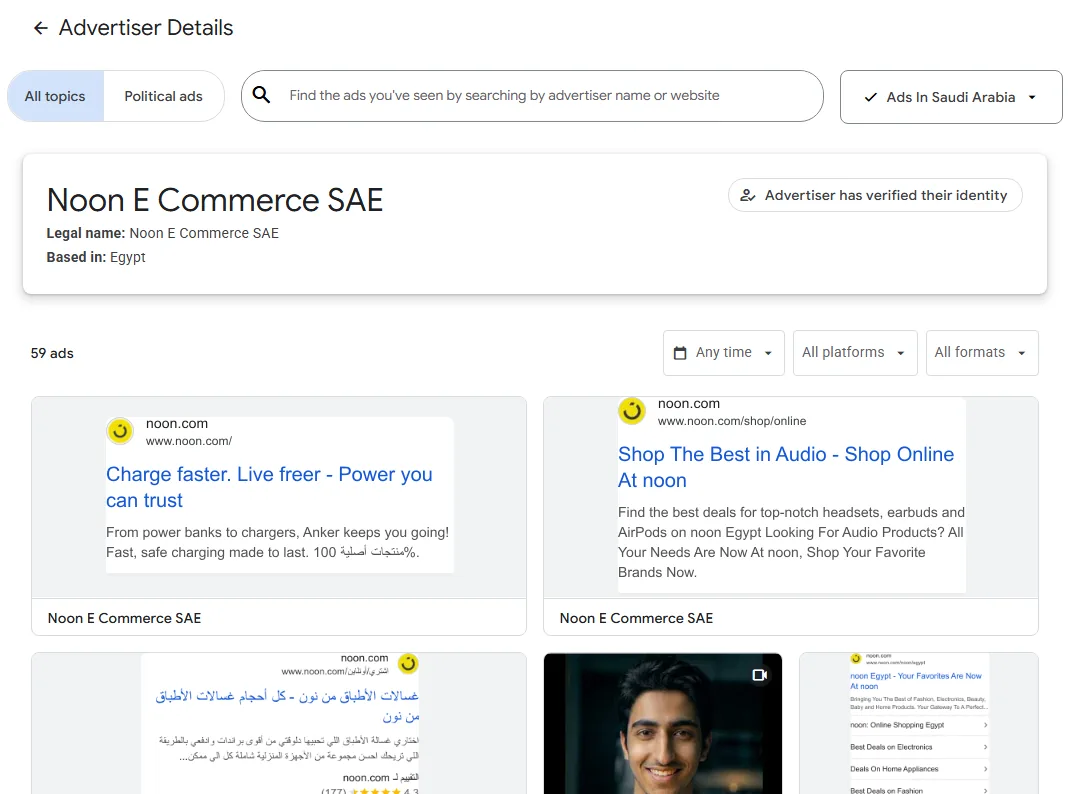
- Legal name and country: is the competitor a local company in the country you are studying, or selling into it from abroad?
- Identity verification: "Advertiser has verified their identity" means Google checked them.
- Number of ads: a sign of how active they are on Google, not a spend figure.
- Search ad copy: headlines and descriptions reveal what they promise in each market: free delivery, a warranty, a price, same-day delivery.
- YouTube videos: what the bigger brands in your category show each country.
A practical use: before entering a new market, open the pages of five advertisers there and record the first promise in their headlines. If everyone promises free delivery, it is a condition of entry, not an advantage.
What the tool does not show
- No keywords or bids: you see the ad, not the keywords the advertiser bought in each country.
- No budgets: except for political ads in some regions.
- Search by advertiser, not product: you cannot type "perfume" to see every perfume ad in the UAE; you need the advertiser's name or website first.
- Few small stores: most small Gulf stores advertise on Meta, Snapchat and TikTok more than on Google, so a competitor's absence from the tool does not mean they are not advertising.
That is why the picture is completed through the second door: Facebook and Instagram ads by country.
Facebook and Instagram ads by country
In the Meta Ad Library you choose a country (Saudi Arabia, the UAE, Kuwait…) and it shows the ads that ran there, by keyword or Page name. But the results mix languages, and an ad vanishes when it stops.
In GccFY every Arabic ad carries the countries it runs in, you filter by country, product and store platform together, and you sort by longest running. From our study of the newest 160,000 Arabic ads (2026-10-25 to 2026-11-06): Saudi Arabia is in 35% of the ads, the UAE in 26% and Kuwait in 18% (an ad can run in several countries):
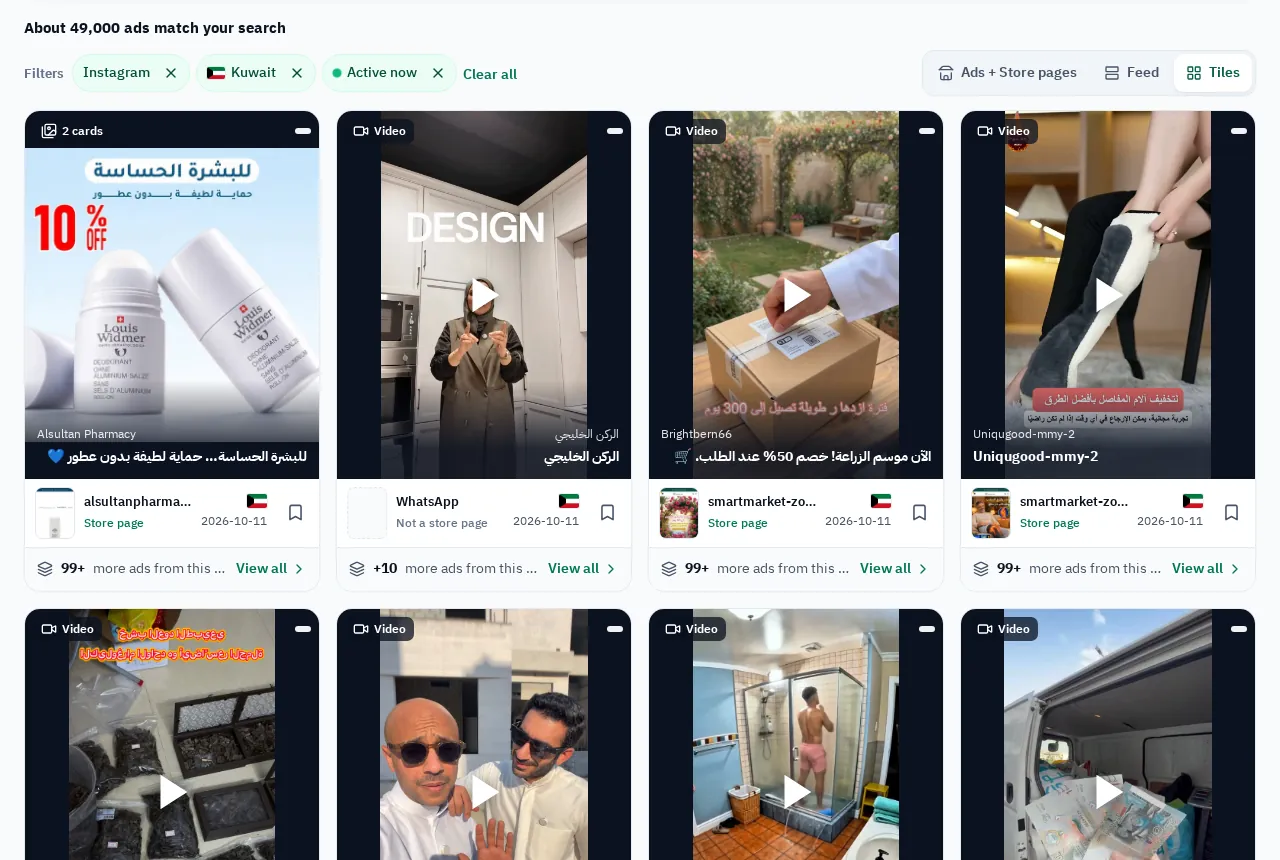
And the markets really differ in the offers themselves: a discount or an offer appears in 40% of UAE ads against 35% in Saudi Arabia and 34% in Kuwait, and "limited time" in 20% of UAE ads against 15% in Saudi Arabia. For the full Saudi-versus-UAE comparison read Saudi Arabia or the UAE?, and for every platform Competitor ads on every platform.
A routine to compare one competitor across three countries
- Google: search the advertiser three times with three regions (Saudi Arabia, the UAE, Kuwait), and record the first promise in their search ads for each region, plus each ad's regions.
- Meta: in GccFY open the advertiser window, or their store domain on the Domains screen, and look at their number of ads per country and the longest running.
- The landing page: open the store page snapshot behind the ad for each country: currency, price and payment method differ between markets.
- The summary: a three-column table (country, Google offer, Meta offer) per competitor. What repeats in both columns is their core offer in that country.
To compare all the official libraries, read Ad libraries compared.